When I first learned that I had Ductal Carcinoma In Situ (DCIS) in early April, I knew that I was going to have surgery and probably radiation in front of me. I was super bummed to learn that my surgery was going to prevent me from being able to do strenuous activity and probably keep me off my bike for at least 4 weeks. But my outlook for returning to my normal fitness activities grew even more dismal when I found out I didn’t just have DCIS, but I had Invasive Ductal Carcinoma (IDC). This meant I was going to have more surgeries that would push back the timeline for being able to resume strenuous activities and now I was looking at chemotherapy in addition to the radiation.
My doctor told me that remaining active during my treatment would be very important for getting through my cancer treatment. While they told me it was going to be crucial for me to listen to my body, I should get up and move when I felt like it and rest when my body was telling me to slow down. I knew that cancer treatment was going to be hard on my body and that I could experience some bone loss as a result of the estrogen blocking. I was determined to commit myself to not only keeping up with my road cycling, but adding in strength training to help prevent bone loss and to improve my overall fitness.
Benefits of exercise during cancer treatment
There are a lot of benefits associated with starting or continuing exercise during cancer treatment. I know that I associated extreme fatigue with all chemotherapies and figured that a lot of times people were encouraged to just rest. However, as I did just a little bit of research, I realized that any movement that people can manage during treatment will actually help to improve fatigue. According to the Mayo Clinic, benefits of exercise include:
- Improved mood, lessened anxiety
- Increased energy and strength
- Decreased pain
- Change in tumor microenvironment reducing risk of recurrence
- Trigger anti-tumor immune system activity
- Decrease/maintain healthy weight (overweight and obesity are risk factors for cancer)
There aren’t really restrictions for people, just because you have cancer. If you have the energy, you should basically go for it. The nurse was mentioning to me at one of my treatments that there was a breast cancer patient who was a big marathon runner. She continued to run everyday throughout her treatment. She wasn’t exactly cranking out the same mileage as before her treatment, but she was able to keep a significant amount of her fitness. Hearing stories like that inspires me, and I want to be like them and do the same. I’m determined not to let cancer get the best of me and take away the things I truly enjoy the most.
My fitness tools
Strava
Ever since I started cycling, I’ve been using Strava – a very popular fitness application for cyclists and runners. The guys who started Strava had the idea back when they were in college and did competitive rowing. They spent a ton of time training and very little competing, so they wanted to create an app that athletes could use to keep track of their training data and build a community of friends to share that data with. Strava tracks your routes, personal records, workouts, power output, heart rate, cadence, etc. They’ve added a ton of functionality over the years and it is a great way to stay active and encourage your friends. Many people who use it joke that if it’s not on Strava, it probably didn’t happen.

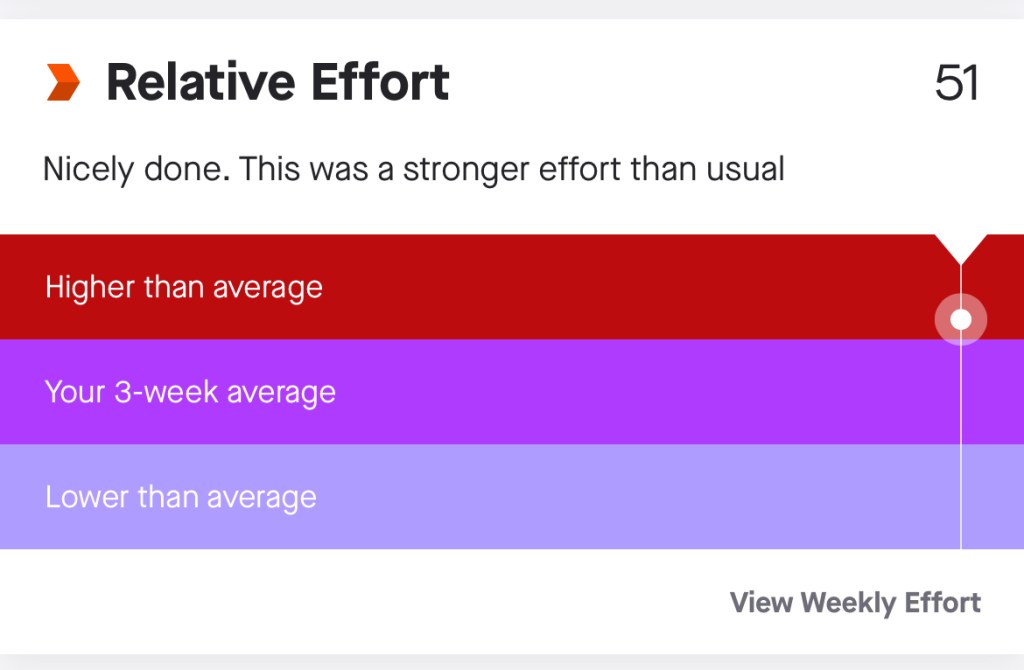
I rely on Strava to help me train and prevent overtraining. For each of your workouts or races, it will assign a “relative effort” rating based upon your heart rate during the activity relative to your maximum heart rate. It will also generally be higher for extended efforts like long rides. It adds these relative efforts over the week to give you your Weekly Intensity and it will provide suggested ranges to stay in for active recovery, maintenance or growth. Finally, it presents your monthly fitness which is a calculation of your training and recovery over time.
MyFitnessPal
I also like using MyFitnessPal to track food and nutrient intake. I think this might be really important as I go through cancer treatment, because the various aspects of my cancer treatment are going to put me into a menopausal-like state which could make weight gain a little easier. Also, I like to track my nutrients from day to day to ensure that I’m getting enough. For instance, since I’m particularly worried about bone loss, I want to make sure I’m getting 120% of my daily calcium requirement at least. B-vitamins can be really helpful to avoid nausea and vomiting (something I learned during pregnancy when you can’t take almost anything!), so I’ve made a concerted effort to eat a variety of foods that have all the B-vitamins as opposed to relying on a vitamin.
Garmin Fenix 6S Fitness Watch
Last September, I chose to purchase a new fitness watch. I had previously had a Fitbit and then I had an Apple Watch. The accuracy of the FitBit’s calorie burn seemed very off to me and it didn’t have enough functionality for me. They have a lot more functionality now like pulse oxygenation and wrist-based heart rate. The Apple Watch had too much functionality as a smart watch. It offered too much of the same functionality as my phone and I started to hate all of the notifications. When I decided to get a new watch, I wanted one that was better for my fitness training, wasn’t quite as Smart Watch-y as the Apple Watch, but still had most of the fitness metrics I needed to support training. I decided to look into the Garmin watches and that’s how I found the Fenix 6S. It offered decent sleep tracking, recovery monitoring, wrist-based heart rate, pulse oxygenation and heart rate variability. The watch then connects to the Garmin Connect app, which presents all of this data to you to help you make decisions about training and recovery.
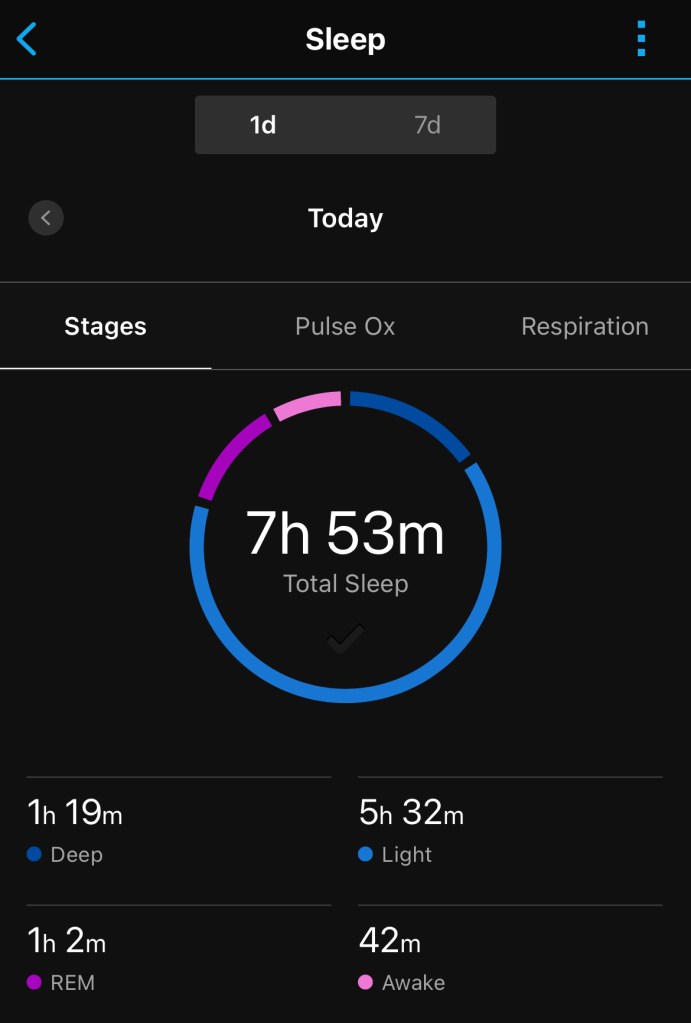
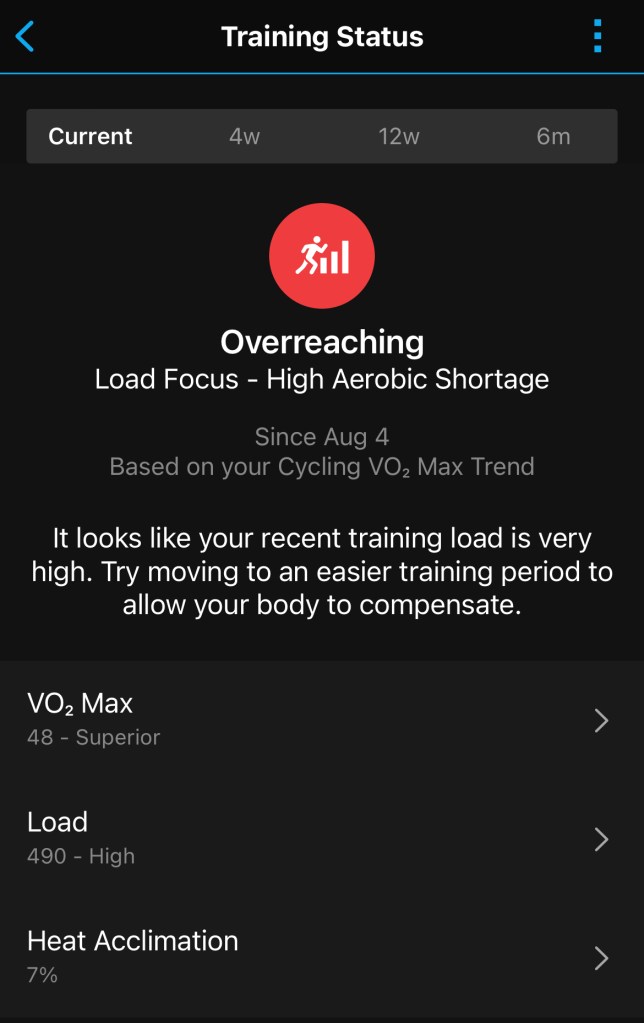
The main things I look at are my Sleep, Training Status, Stress and Body Battery. Sleep gives you a breakdown of the amount of time spent in the different sleep stages and you can look at Sleep Score that gives you an evaluation of how ideal your sleep was given the overall amount of sleep and if you spent adequate time in the various sleep stages. Training Status looks at your VO2 Max, your overall training load over compared to the last several weeks and your heat acclimation. Stress is calculated based on your heart rate variability throughout the day and uses a 3rd party algorithm to gauge how “stressful” your day was and if you spent enough time resting to avoid bottoming out. I’ve included some screenshots of examples of all of these. You will notice that right now it gauges that I’m overreaching because I’ve somewhat aggressively ramped up my training since not having worked out after my surgeries. I’m going to try to take it easy the next few days so I have time to recover.


Finally, the Body Battery helps to look at your stress throughout the day in combination with the rest you get during sleep and exercise to show you how much or if you have adequately recovered. Some days when I don’t get very restful sleep, my body battery doesn’t fully charge and I can usually feel like. On days like that, it’s probably best to take it easy. What’s really crazy is how I can see the impact of sugary treats or alcohol on my sleep. Usually my sleep isn’t very restful and it takes awhile for my stress levels to come down.
These are the tools I primarily rely on to track my training, fitness and nutrition. Using Strava is easy and fun, so I use that quite regularly and easily. MyFitnessPal is a little more work and not quite as fun to look through, so that’s going to be a bit more of a challenge. My watch is definitely something that I use on an hourly and daily basis. But you do have to sometimes listen to your body and not completely adhere to your watch. After all, these are just instruments with imperfect measuring relying on imperfect algorithms to create this information. Sometimes my watch would suggest I shouldn’t work out, but I feel great. Conversely, it can tell me I’m fine but I’m just not feeling it. Regardless, you have to listen to what your body is primarily telling you!
My actual fitness plan
Cardio
I’m finally getting further out from my surgeries, especially my bigger surgeries like my lumpectomy (May 27th) and my Sentinel Node Biopsy (June 22). I’ve been able to resume cycling and even riding outside. Prior to all of this, my goal was to ride 6 times a week. I think that’s too aggressive of a schedule to maintain given my treatment, so I decided to set a more realistic goal of 4-5 times per week. I think my treatments are working my body pretty hard, too, so I don’t want to overdo it.
Also, I’m going to focus mostly on Zone 2 training with a sprinkle of HIIT. Sean has listened to Peter Attia’s podcasts for awhile and he shared one with me about Zone 2 training and its relationship with improved mitochondrial function. In that episode of the podcast, he interviews a cycling trainer and researcher, Iñigo San Millán from the University of Colorado School of Medicine. Zone 2 refers to the range of your heart rate that keeps you below your lactate threshold (where your body starts to generate lactic acid). This is essentially the level of effort you can maintain for very long periods of time without really tiring significantly and it won’t drive your heart rate up. It generally ranges between 65% – 75% of your maximum heart rate. Based on San Millán’s and other’s research, you can actually do a lot more Zone 2 training and still increase cycling metrics like your Functional Threshold Power (FTP) without doing a lot of high intensity training. Also, this has significant benefit for your mitochondrial function that can be protective against things like Diabetes.
I will also try to spice up my routine with a couple of harder efforts in there, but I will probably reserve those for the days that I ride outside on the weekends. It’s a lot harder to go easier outside than it is when I ride on my trainer inside. Inside, I can easily maintain a constant cadence and power output to keep my heart rate stable at a particular level for an extended period of time – perfect for Zone 2 training. When I’m outside, there’s a lot more stopping and starting at lights and stop signs. Also, I hate to let people pass me on my rides, so my competitive streak comes out a bit more.
Weight Lifting
I used to weight train a lot starting in high school. It was something I enjoyed a lot and I always felt it helped to reduce the likelihood of injury during my competitive sport seasons by keeping the muscles around my ligaments strong. I continued my weight training into college and actually maintained a pretty religious schedule of three times per week and working all muscle groups. Unfortunately, after I graduated from college, weight training really dropped off my radar. I still maintained cardio, but I just couldn’t find the time for weight training.
In my first job, I received a fitness stipend to buy something fitness related each year (e.g. new running shoes, etc.). I decided to buy the Beachbody P90X fitness routine. The first week I did that workout routine, I could barely lift up my arms. Sean needed to help me get dressed because I couldn’t lift my arms up enough! I kept going, but I ultimately did not finish the 13-week program. It’s kind of funny, because I don’t know if I’ve ever completed a full 12-week program, but I guess I can check that box once I finish chemo! But part of the reason I don’t think a program like P90X ended up being ultimately successful for me was that it was meant to be a full exercise program that didn’t incorporate my cycling, so it was too time consuming. Also, if you missed a day or two, it felt really demotivating because it was like you already didn’t successfully complete the program.
All that to say I’m extremely motivated to get back into weight training. First, I know it’s something that I probably should be doing anyways for my general health. Then, I am concerned about bone loss during this treatment and with having to go through an early menopause with taking Tamoxifen after my active treatment ends. I’ve designed a weight training routine shown below.
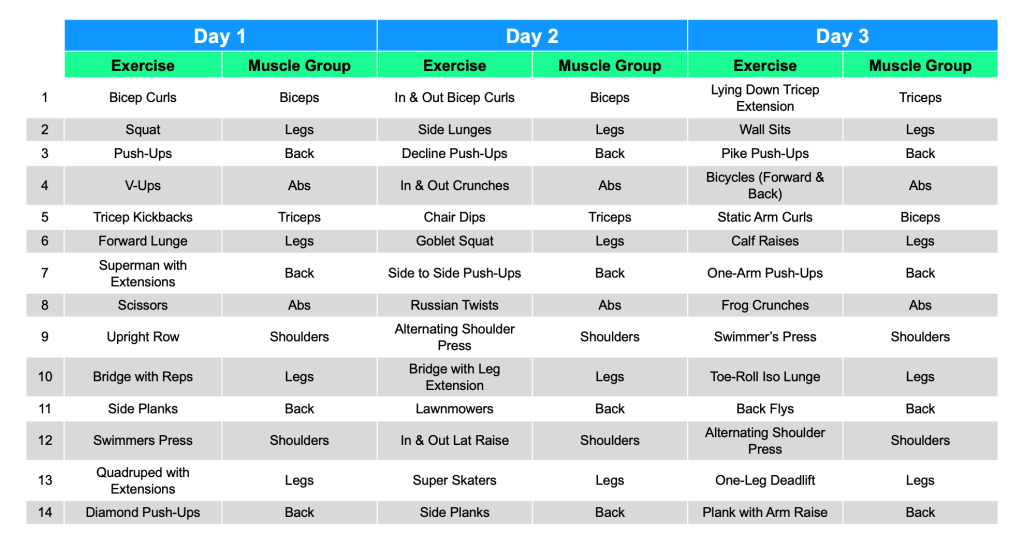
I wanted each day to be a full-body routine and I wanted each day to be different to add some variety. I complete the entire routine three times. I will also incrementally increase the weight for weighted exercises as the weeks go by as long as I can maintain it. Some of these exercises were favorites from my P90X routines and some are fairly common weight lifting moves.
Progress so far
I’m three full weeks into treatment at this point and I’ve finally built up to my goals. I had to build up my cycling a bit so that I didn’t overdo it. But I’ve also been able to complete my weight training goals for those weeks as well. I’ve been fortunate that my treatment has allowed me to maintain this, but I can definitely say that I think keeping up with this routine is giving me energy and helping me stay strong through my treatments! I would recommend and strongly encourage anyone going through this to push through as well. Even if you previously didn’t have much of a regular exercise routine, you can start slow and easy – but get up and move! It seriously will help to make you feel better and feel positive!
 Want a Cuke?
You’ve inspired me to be more regular and comprehensive in my weight training. An exaggeration as I almost only do push-ups and triceps dips a couple days a week haphazardly. Have a chart system that I will reactivate! Xoxo
LikeLike